






 Instellingen
 Snelle levering
 Gratis verzending
 Incoterms
 Betalingswijzen


 Marketplace-product

Low-Quiescent-Current Buck Converters Maximize Battery Life
Bijgedragen door Electronic Products
2013-11-12
Extending and conserving battery life is critical to many portable systems in the field, such as remote sensors, because low battery power can mean losing valuable sensor data. What’s more, changing batteries may not be practical or cost-effective in many applications due to the location of the battery-powered device. As a result, voltage regulators that convert battery input voltage to the desired level in these systems must themselves consume ultra-low power, especially when the system is in idle or standby state.
By design, to conserve power these systems actively switch between idle and active states. In fact, remote monitoring systems spend most of their time in a low-power idle state, but require bursts of high power for transmitting data. These types of applications require minimal current consumption in the idle state to maximize battery life, and a seamless transition to active mode when called on to supply several watts of power.
The voltage regulators employed in such systems must, then, also be able to do the same. Besides maintaining a well-regulated output voltage during low-current idle states, these regulators should be able to quickly and automatically adjust to changing load conditions. In addition, they must provide necessary voltage for keep-alive functions.
Keeping these factors in mind, Linear Technology has released ultralow-quiescent-current monolithic step-down regulators designated LT3971 and LT3991. While delivering high performance at both high and light loads, they draw only 1.7 μA of quiescent current when in light-load situations. However, both these regulators can source up to 1.2 A when needed. The only difference is in the input voltage range. The LT3971 is rated for an input voltage range of 4.3 to 38 V and LT3991 offers a wider input range of 4.3 to 55 V.
Ultra-low quiescent current
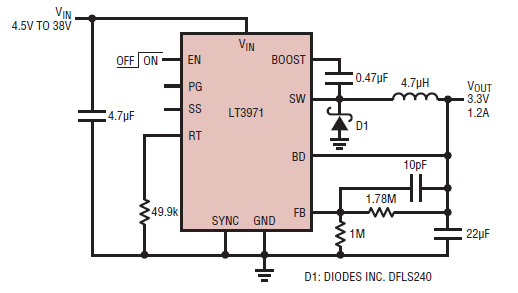
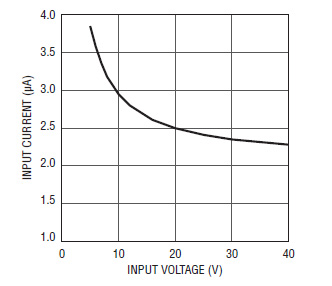
As per the discussion in the Linear Technology design feature titled “1.2 A Buck Converters Draw Only 2.8 µA When Regulating Zero Load, Accept 38 VIN or 55 VIN ” by John Gardner,¹ when the output load is low, the LT3971/LT3991 decreases the switching frequency to deliver power to the output only when needed. Between current pulses, most of the part’s internal circuitry is turned off, to reduce the quiescent current to only 1.7 μA. Even with no load current, the feedback resistors and the leakage of the Schottky catch diode acts as a load current of a few microamperes, increasing the quiescent current of the application circuit. By using a few megohms of feedback divider resistance and a Schottky catch diode (Diodes Inc.’s DFLS240) with low leakage (Figure1), only 2.8 μA of input current is consumed when regulating a 3.3 V output with no load from a 12 V input. The design article shows that the application circuit in Figure 1 is capable of achieving low input current over the entire input voltage range when regulating a 3.3 V output with no load (Figure 2).
According to the manufacturer, the quiescent current of the LT3971/LT3991 is exceptionally low, even when compared to the self-discharge of a battery. It is well known that rechargeable batteries have significant self-discharge; a nickel cadmium (NiCd) battery can lose about 15 to 20 percent of charge in a month. The Linear Technology paper points out that nickel metal hydride (NiMH) batteries can be even worse, with “low self-discharge” NiMH batteries losing about 15 to 30 percent of its charge per year. Similarly, lead-acid batteries discharge several percent of their charge per month and lithium secondary batteries discharge about half as quickly.
According to Linear’s John Gardner, these discharge rates correspond to over 100 μA of self-discharge in the worst case and tens of microamperes in the best case. Gardner indicates that primary batteries have much lower self-discharge rates. Consequently, alkaline and lithium primaries can take up to 5 to 15 years to lose 20 percent of their charge. Per Gardner’s explanation, this corresponds to only a few microamperes of self-discharge current. By comparison, the LT3971’s quiescent current is over an order of magnitude less than the self-discharge of rechargeable batteries. As a result, LT3971’s impact on battery life is very small. Primary batteries, however, have self-discharge comparable to the LT3971’s quiescent current. In that case, the battery only drains about twice as fast as it would if it was just sitting on a shelf, Gardner points out.
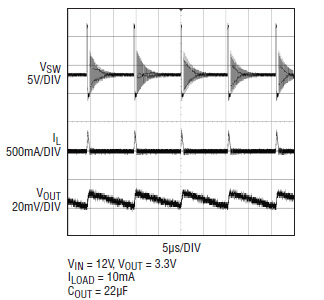
Regarding the output voltage ripple, the LT3971/LT3991 datasheet shows that the parts offer less than 15 mVPP across the full load range. During light-load situations, the regulator enters burst-mode operation where single current pulses are used to recharge the output capacitor when the part detects the output voltage has dropped below the regulation value. Single-pulse operation is critical to controlling output voltage ripple, because multiple pulses would quickly charge the output capacitor excessively, according to the explanation in the Linear Technology design article. The peak of each current pulse is set to about 330 mA, generating consistent ripple performance across the burst-mode operation load range. The switching waveforms in Figure 3 show the ripple performance for a 10 mA load.
Uncompromised performance
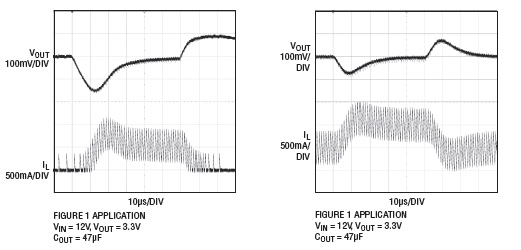
The manufacturer says that no compromises were made to achieve LT3971/LT3991’s low quiescent current. In addition, the part offers good transient performance with a full feature set. The peak current-mode control scheme with internal compensation maintains good stability across load and temperature. However, to achieve this performance, Linear recommends using a 10 pF phase lead capacitor between the output and the FB pin. The measured response to a 0.5 A load step, starting from both a 0.5 A load and a 25 mA load, is shown in Figure 4. As illustrated, the regulator displays smooth transitions between burst-mode operation and full switching frequency.
The LT3971/LT3991 switching frequency can be programmed between 200 kHz and 2 MHz with an external resistor. By connecting an external clock to the SYNC pin, the switching frequency can be synchronized as fast as 2 MHz. A soft-start feature limits the inrush current of the part by throttling the switch-current limit during start-up. The SS pin is actively pulled down when the enable pin is low.
Because the quiescent current of the LT3971/LT3991 is very low in shutdown mode, the internal bandgap reference can still operate, consuming only 700 nA of input current. This feature allows the regulator to offer a 1 V enable pin threshold when VIN is above 4.3 V. Consequently, when the enable pin is above 1 V, the part is enabled and can switch, and when the enable pin is below 1 V, the part is shut down and cannot switch, according to Linear.
In short, the ability of the LT3971/LT3991 to supply this type of pulsed load is very important for satisfying the needs of low-duty-cycle sensor and energy-harvesting applications, which can take advantage of both the ultralow quiescent-current performance and 1.2 A maximum load of the monolithic step-down regulators LT3971 and LT3991.
For more information on the parts discussed in this article, use the links provided to access product pages on the DigiKey website.
Reference
- “1.2 A Buck Converters Draw Only 2.8 µA When Regulating Zero Load, Accept 38VIN or 55VIN, ” by John Gardner, Design Engineer, Linear Technology Magazine, December 2009
Disclaimer: The opinions, beliefs, and viewpoints expressed by the various authors and/or forum participants on this website do not necessarily reflect the opinions, beliefs, and viewpoints of DigiKey or official policies of DigiKey.








 België