Instellingen
 Snelle levering
 Gratis verzending
 Incoterms
 Betalingswijzen


 Marketplace-product


Compact High-Voltage Regulators Power Modular Pulsed Electric Field Designs
Commercial pulsed electric field (PEF) applications are designed to deliver massive, repeatable pulses that inactivate microbes and extend the shelf life of food and beverages without heat or chemicals. Optimized for scale, reliability, and long operating lifetimes, they are typically custom-built, generally expensive, and inflexible. That creates market opportunities for modular, pilot-scale designs utilizing off-the-shelf components.
XP Power offers a line of regulated high-voltage power converters that designers can use to build modular PEF systems across lab, pilot, and commercial applications without relying on fully-custom power solutions. The company's HRL30 30 W converters function as the regulated high-voltage supply that can charge capacitors or pulse-forming networks (PFNs), which then feed controlled pulses through a switching stage to electrodes, sensors, or treatment cells.
Supporting controlled, repeatable downstream pulses without requiring a custom high-voltage supply, the HRL30 converters provide designers with more freedom to experiment, rapidly iterate, and create new application-specific innovations.
Smaller, modular designs
Designers can build modular high-voltage systems around an HRL30, treating it as the regulated energy core for a range of subsystems. From there, charged PFNs feed controlled pulses through switching modules to electrodes or treatment cells, while monitoring and control electronics track voltage, current, and temperature.
Mechanical enclosures and baseplate cooling simplify safe integration into lab rigs, pilot-scale PEF modules, or OEM subsystems. By combining these building blocks, teams can rapidly prototype, iterate, and adapt designs without having to design a custom high-voltage supply for each application.
The regulators operate in constant voltage and constant current modes with automatic crossover, allowing for a controlled charge rate to a capacitor. The output voltage can be programmed from 0% to 100% via a 0–5 V analog signal, allowing the system to dynamically adjust the target charge voltage, and thus pulse intensity.
The XP Power converters provide voltage and current monitoring outputs (Vmon and Imon) for automated testing, logging, or closed-loop control. These signals allow an external microcontroller or programmable logic controller to detect when the capacitor is fully charged, trigger the pulse, and initiate the recharge cycle.
Stable, controlled energy delivery
The HRL30 architecture supports a wide range of systems that deliver high voltage as a defined, repeatable function. This allows design teams to focus on application performance and system integration instead of designing custom high-voltage supplies. Compact mechanical enclosures and baseplate cooling enable easier, safe integration with larger systems.
The key challenge with PEF applications is not just generating high voltage but delivering it safely and predictably. The HRL30 series provides stable, regulated energy to PFNs, capacitor banks, or other high-voltage storage elements that feed downstream pulses.
PFNs are combinations of capacitors and inductors that store energy and release it as short, repeatable pulses. The PFN defines the pulse shape, duration, and amplitude, while the HRL30 manages safe, reliable energy delivery and allows designers to focus on tuning performance rather than building a custom high-voltage supply.
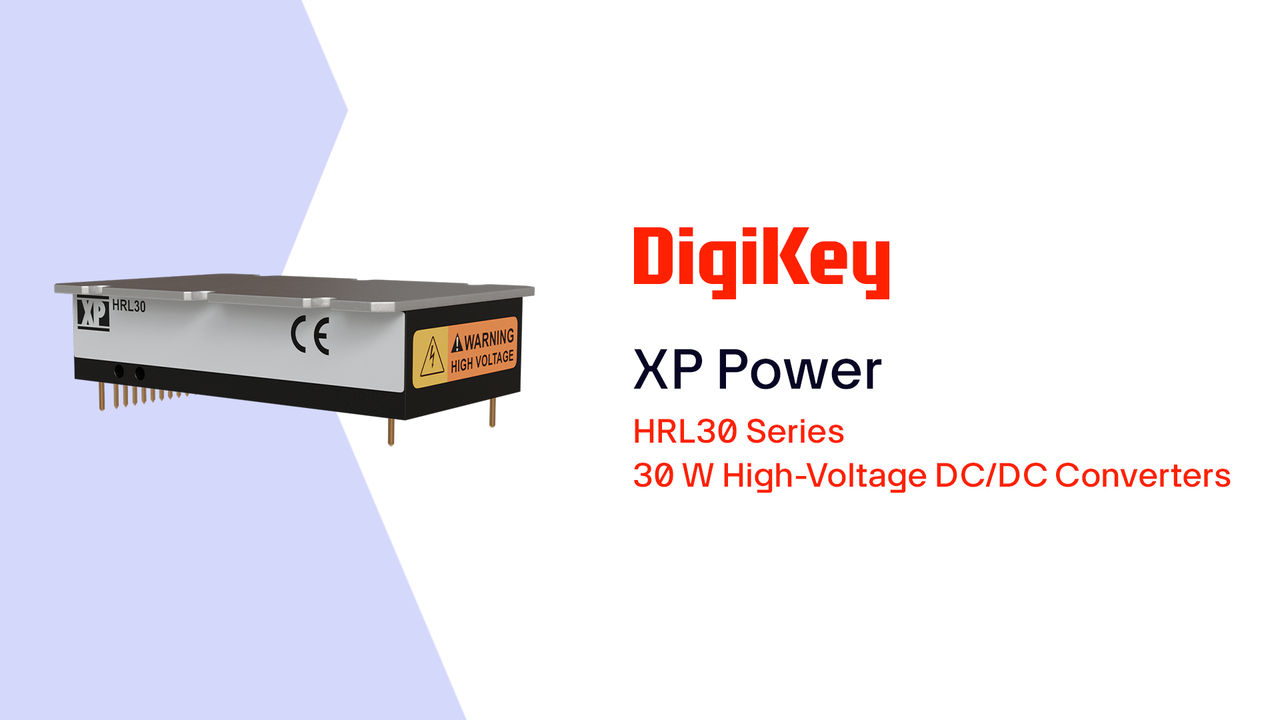
Designers can map the electrical requirements of their applications to HRL30 variants that share a compact, baseplate-cooled form factor of 3 in. x 2 in. x 0.73 in. (Figure 1).
 Figure 1: The HRL30 product line shares a common form factor and baseplate-cooled design. (Image source: XP Power)
For example, here are three parts that illustrate how voltage and current can be matched to electrical requirements:
- At the lower-voltage end, a model like the HRL3024S350P delivers up to 350 VDC at roughly 85 mA, making it well-suited for designs that benefit from higher current, such as faster charging of capacitor banks, moderate-field PEF experiments, or electrophoresis-style systems where energy per pulse matters more than extreme field strength.
- Stepping up, the mid-range HRL3024S600N delivers up to -600 VDC at about 50 mA, balancing voltage and current for lab-scale or pilot PEF systems that need meaningful electric fields without pushing insulation, spacing, or system complexity too far.
- At the higher end, the HRL3024S5K0P delivers up to 5 kVDC at approximately 6 mA, prioritizing electric field strength over current. It is suitable for small pilot-scale PEF modules, laboratory electroporation setups, or instruments requiring precise high-voltage biasing rather than high delivered energy.
Conclusion
As designers push PEF into pilot-scale, modular, and application-specific systems, the ability to generate high voltage safely, predictably, and without custom power design represents a market opportunity for modular approaches that lower costs, accelerate development, and open the door to a wider range of practical implementations. XP Power’s HRL30 series provides a regulated high-voltage foundation that lets teams focus on pulse shaping, electrodes, and system performance rather than the risks of high-voltage supply design.
Achtergrondinformatie over deze auteur

Pete Bartolik is een freelance schrijver die al meer dan twintig jaar onderzoek doet naar en schrijft over IT- en OT-kwesties en -producten. Daarvoor was hij nieuwsredacteur van de IT-managementpublicatie Computerworld, hoofdredacteur van een maandelijks computertijdschrift voor eindgebruikers en verslaggever bij een dagblad.

Have questions or comments? Continue the conversation on TechForum, DigiKey's online community and technical resource.
Visit TechForumMeer blogs van deze auteur